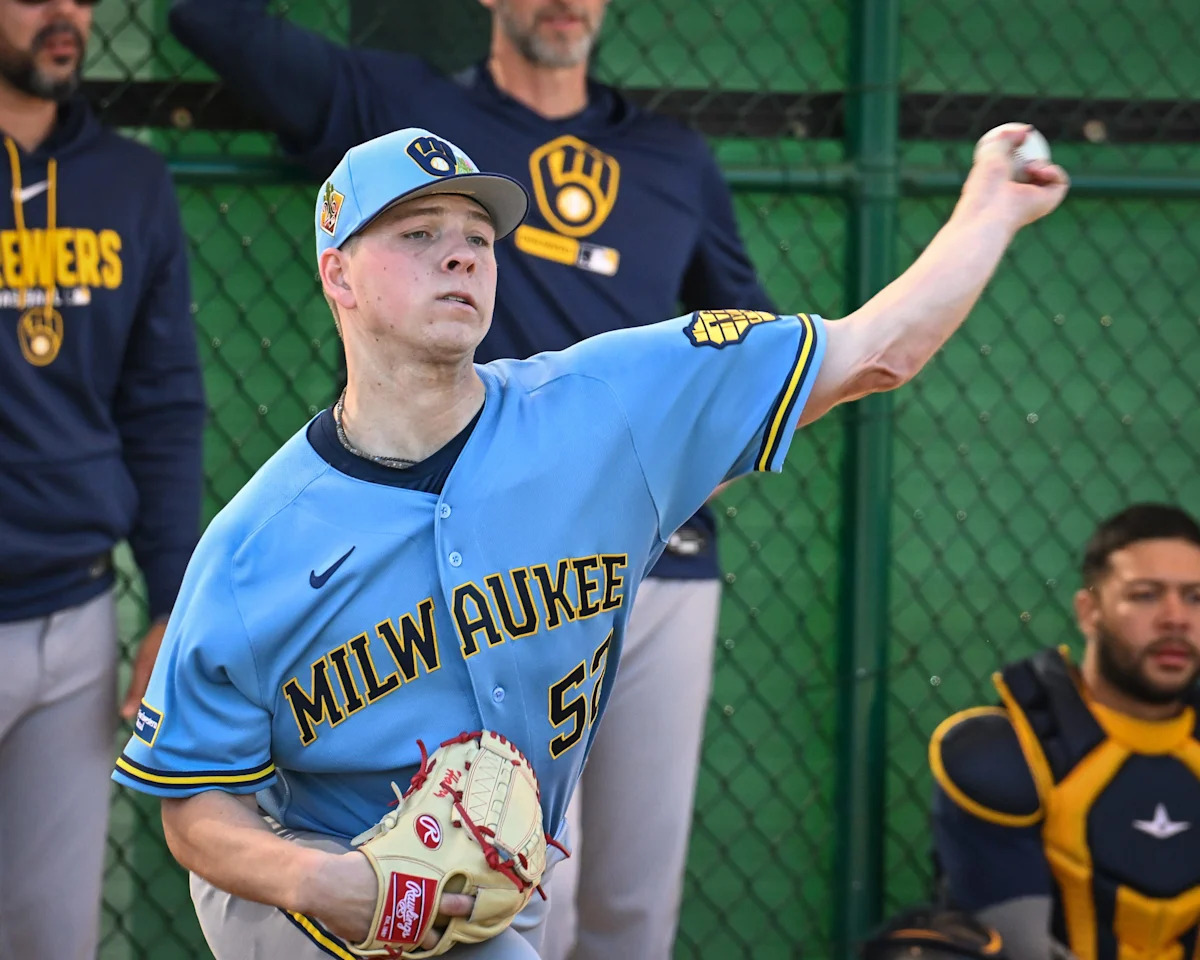
While Brandon Sproat is my pick to be the next Brewers “pitching lab” success story, I started writing that article before the Brewers traded for left-hander Kyle Harrison (4.09 ERA in 2025). Harrison — the main piece acquired in the trade that sent Caleb Durbin to Boston— might have an even more intriguing profile. He’s a former top 25 overall prospect who the Red Sox liked enough to make him the centerpiece in the trade that sent slugger Rafael Devers to San Francisco. He seems like a perfect candidate for the Brewers “lab” to work some of its magic.
I don’t put very much stock in the fact that Harrison hasn’t exactly impressed in the majors, nor that he lost his spot in the Giants’ rotation to Landen Roupp (who, by the way, has a very respectable 3.73 career ERA). Harrison has a ton of potential but is in need of some more development. That might be worrying, maybe, if he wasn’t already ahead of schedule. When Harrison made his debut as a Giant, at 22 years old, he was the youngest pitcher to pitch in a Giants uniform since Madison Bumgarner. He’s already spent a full season in a major league starting rotation. It’s not like San Francisco desperately wanted to unload Harrison either; most general managers would have traded Harrison for Rafael freakin’ Devers.
Advertisement
Harrison was originally drafted in the third round by the Giants back in 2020. While he was drafted over five years ago, he was drafted out of high school, so at 24 years old, he’s still younger than a few notable Brewers prospects — Sproat (25), Craig Yoho (26), Robert Gasser (26), and Coleman Crow (25) are all older than Harrison. He’s not much older than Logan Henderson, Jeferson Quero, and Brock Wilken, who are all 23. Harrison is the same age as Tyson Hardin, and the same age that Quinn Priester was when Milwaukee traded for him.
To me, there are some Priester parallels with Harrison. Harrison, like Priester, was picked high in the draft and was a top prospect for a couple of years. Harrison didn’t exactly light the world on fire in his first full season in the Giants rotation, pitching to the tune of a 4.56 ERA with 118 strikeouts in 124 1/3 innings pitched. Neither did Priester, who lost his rotation spot to Richard Fitts (5.00 ERA in 10 starts in 2025). Fitts is now in St. Louis, and Priester just put up a 3.32 ERA in Milwaukee.
MLB statistics definitely matter when evaluating Harrison, but when you look at the big picture, the acquisition starts to look more promising. Numbers in this small of a sample size can also be somewhat misleading. If Harrison had simply not made his last start of the season (3 ER in 3 IP against the Tigers), he would have finished the season with a 3.58 ERA.
Think of Harrison like a prospect. He’s still as young as some prospects and is uber-talented, but comes with the added bonus of big-league experience. He’s already shown flashes of what he could be, but he hasn’t been consistent enough to justify a featured role thus far in his career. Now, Harrison is in an organization known for “unlocking” pitchers, of getting the most out of new acquisitions. With some tweaks, he could justify his former ranking as a top prospect in baseball as soon as this season. Here’s everything you need to know about Harrison’s current arsenal and how it might look different in Milwaukee.
Advertisement
Harrison’s Fastball
Harrison’s fastball is a “problematic pitch,” as put by Steven Kennedy from McCovey Chronicles. The “problem” is actually paradoxical — his fastball is really, really good, but in his only full season as a starter (2024), he threw it more frequently than any other starting pitcher in baseball. No pitcher is going to win a Cy Young throwing his fastball nearly 60% of the time, but part of the reason that Harrison’s heavy fastball usage became “problematic” is that his average fastball velocity declined from what it was in 2023. In 2023, Harrison averaged 93.6 mph on his fastball. In 2024, that number dipped down to 92.5 mph.
Harrison has never thrown super hard, but his fastball (characterized by a late-rising movement) has always been effective as a result of its shape. The decline in velocity led to a decline in movement. Together, both led to a decline in overall effectiveness.
Here’s what The Athletic baseball writer Grant Brisbee said about Harrison prior to the 2025 season:
Advertisement
“If Harrison levels up with his offspeed stuff or with his command, or ideally both, his ceiling is where you might expect a former top-20 prospect’s ceiling to be. If it’s just a mid-90s fastball that carries him, he’ll still help the Giants toward the postseason. If the fastball is what we saw toward the end of last year and the offspeed stuff and command don’t improve, the 4.56 ERA (85 ERA+) doesn’t have to be a blip or something that can be written off because of inexperience.” Brisbee and Kennedy both characterized Harrison as someone who “can be, and has been, a serviceable starter at the back-end of a rotation purely on the merits of his four-seam. What prevents him from filling a more elevated rotation role is his secondary pitches.” From reading other scouting reports, most people seemed to view Harrison similarly — a back-end starter at worst, a high-end starter if he can develop his secondary offerings.
One good sign for Harrison’s development is that he got his velocity back — and then some — in 2025. Harrison’s average fastball velocity in 2025 was 94.6 mph (over 2 mph faster than in 2024). Unsurprisingly, his fastball also played better. Opponents hit .249 against it in 2024 and .195 in 2025. Simply put, I wouldn’t worry about the fastball.
Harrison’s secondary stuff, however?
Harrison’s Secondary Offerings
Harrison’s secondary offerings, for most of his career, have left something to be desired. The narrative on Harrison was exactly how Brisbee and Kennedy described him — great fastball, less-than-great secondary stuff. When he was traded to Boston last summer, however, the Red Sox reportedly “started to modify his arsenal, adding a cutter and sinker and tweaking his breaking ball.”
Advertisement
Harrison didn’t throw either pitch all that often in 2025 (22 and 12 times, respectively). Getting either pitch to miss bats consistently would change the equation entirely. The sinker averages a similar velocity (93 mph) to his fastball, but with an entirely different shape. Harrison’s fastball features arm-side movement (away from a right-handed hitter) and significant rising action, while his sinker has arm-side movement but… well, it sinks. Pitching is all about deception, so having two pitches that look very similar until the last 30-ish feet would go a long way towards missing bats. The cutter also shows a lot of potential playing off his fastball, as detailed in this September article from Over The Monster.
While the sinker and the cutter are both new additions, Harrison has also featured a slurve (thrown 27% of the time last year) and a changeup (8%). The slurve has been inconsistent, although it’s been consistently more effective against righties than it has against lefties. Before joining the Red Sox, Harrison’s slurve tended not to “finish its’ shape,” straightening out inside of continuing to break down and towards the glove side. With the Red Sox, however, Harrison was throwing the pitch slightly harder (82.2 mph as opposed to 80.6 mph) and getting an extra 1.6” of vertical break on average. In the Over the Monster article, author Jacob Roy wondered if a “harder breaking ball is the answer” — it seems the Red Sox were already making that adjustment. That may be something the Brewers have also pinpointed.
As for the changeup? Well, who better to hear from than Harrison himself?
“(The changeup) used to be similar to Logan Webb’s changeup — the way he throws his with a one-seam orientation — but I’ve switched to a kick,” Harrison explained. “That’s what I’m trying to harness. It is a little harder to get a feel for. Throwing a kick kind of takes away that being perfect, of trying to pronate a pitch and get to a spot. Now it’s, ‘Throw the pitch and let the kick take care of it.’”
Advertisement
It’s admittedly a very small sample size, and opponents did hit .300 against Harrison’s changeup last year, but they also only slugged .400 — lower than any pitch other than his fastball and his cutter (22 total pitches thrown). Fastball pitchers usually rely on changeups to keep hitters off balance and unable to sit on the fastball, since both pitches are generally thrown with a similar arm angle, arm speed, and release trajectory. A quality changeup would aid Harrison in the same way that a quality sinker would; batters can’t sit on Harrison’s rising fastball when he has a pitch that looks similar out of his hand, but reaches the plate significantly slower and drops inside of rising.
So, what does Harrison need to live up to his potential? Simply put, he needs better shape on his secondary pitches and a go-to secondary offering. As detailed in the Sproat article, Milwaukee has a (literal) pitching lab dedicated to, in the words of former Brewer Josh Hader, learning “how pitches should spin to get optimal drop or movement.” Using that data, they’ve gotten great seasons out of pitchers much less talented than Harrison.
I don’t know whether Milwaukee thinks they can make the slurve the (harder, faster) swing-and-miss pitch it should be, or whether they think the cutter, sinker, or changeup can become plus pitches with some tweaks. I do know that trading a valuable part of last year’s team (Caleb Durbin) and versatile infield depth speaks to their confidence in their ability to get the best out of Harrison. The Brewers think he can live up to his billing as a former top prospect leaguewide, and I’m excited to see how they get him there.
